Our offers
Löv

Many of our customers in Sweden, Norway, Finland and the Alps think winter is the best time for a tent sauna, with snow to cool off in and an ice hole nearby. Most of them keep the tent up at home all year round.
There are three things worth knowing: what happens when snow settles on the roof, how to reach full sauna heat when it's cold outside, and how to look after the tent when it stays up all winter.
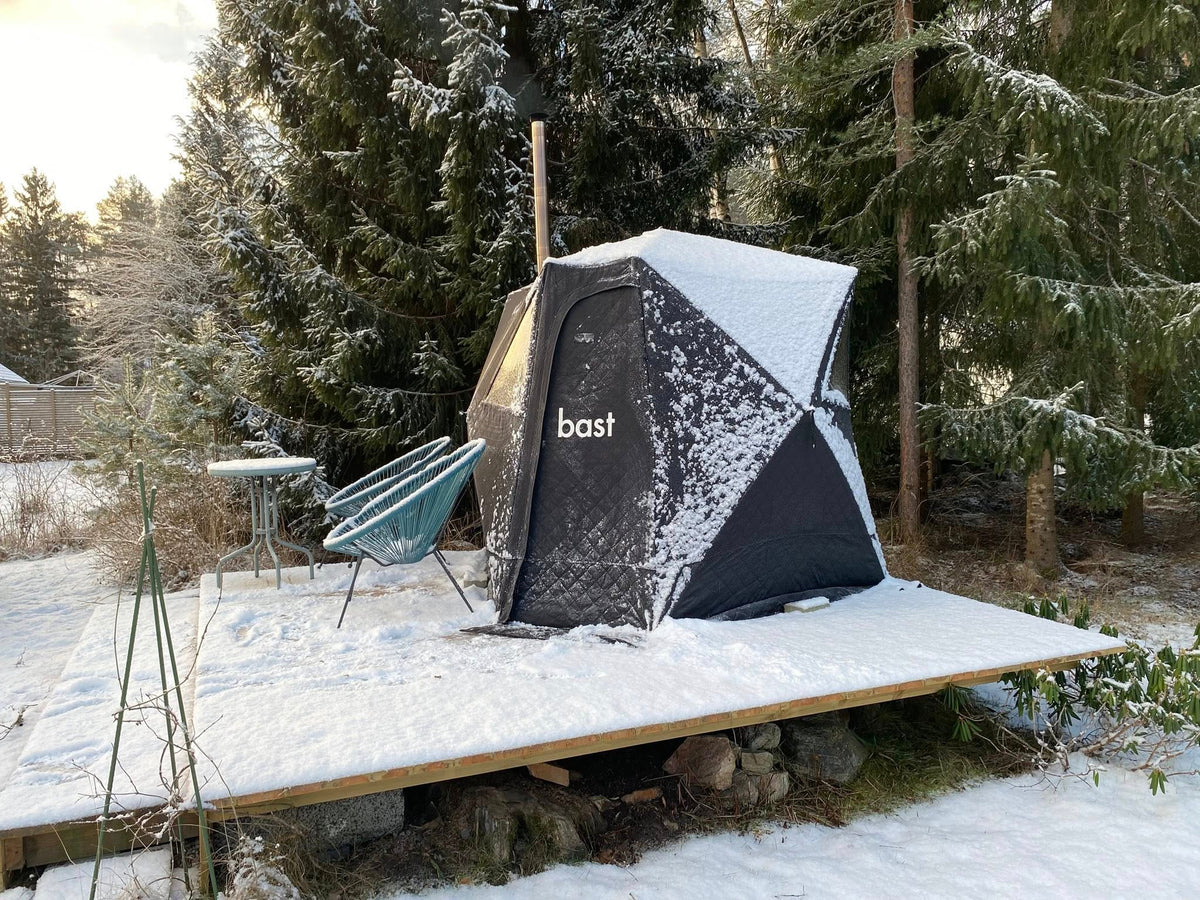
The tent roof slopes down in every direction, so some of the snow slides off by itself. But snow can still build up, especially when a lot falls in a short time. Here's what happens, step by step.

A little snow on the roof does nothing. Use the sauna as usual and brush it off while you're outside anyway.

At 10–15 cm of snow the roof folds in, depending on how wet and heavy the snow is. Brush off the snow and push the roof back up from the inside, and the tent is back in shape.

In the worst case, one of the tent poles in the roof can break. You can easily replace it yourself with a new one.
Spare part: tent poles →A soft brush or snow brush is enough. Do it regularly and don't wait until the snow has packed down and turned heavy.
If the tent is at the cabin, or you're away for a week, nobody can brush off the roof. That's when a roof support helps a lot. More about it below.
If the tent is on a frozen lake, the ground pegs won't hold. Use ice screws instead and the tent stands firm.
If the tent is up and nobody can brush off the roof, the support carries the snow instead of the tent fabric. You can buy one at any hardware store.

Most supports at hardware stores are adjustable in length. Make sure it extends to at least 210 cm.

Place the top of the support against the metal plate in the middle of the roof, so the weight of the snow goes down into the support.

Anchor the foot in the ground or floor so the support stands firm. You can use the sauna as usual with the support in place.
In winter 2023 we set up a sauna tent at home in Luleå, Sweden, when it was -36 °C outside. After 30 minutes of firing it was 80 °C in the tent. At -10 °C we count on about 5 minutes of extra firing. With these tips you'll reach full sauna temperature even in the middle of winter.
Dry birch or other hardwood gives the most heat. Damp wood burns worse, gives less heat and more soot.
The smaller the logs, the more efficient the fire. Start with small pieces and you'll quickly get a good bed of embers.
Don't leave the wood in the tent. It gets as cold as the air outside and takes longer to get going. Keep it indoors so it's warm and dry when you light the stove.
The included fabric floor insulates against the cold coming up from below.
Put heavier weights along the tent skirt, both inside and out, so as little cold air as possible gets in under the tent fabric.
Heat rises and the ground is cold. With a two-level bench, ours or one you build yourself, you sit higher up in the heat and keep your feet off the cold ground.
The window covers keep the heat in even better when it's really cold outside.
The weather cover can stay on while you use the sauna and adds an extra layer that helps keep the heat in.
Keep the ventilation open. Don't close the tent's vents to get the heat up, they're needed for air exchange throughout the session.
From a garden in southern Sweden to the ice in northern Sweden.
Sets up the sauna tent on a winter day at home in southern Sweden.
Running on the ice and recovery in a sauna tent.
Sets up the sauna tent out on the ice.
Many of our customers keep the tent up all year round. These are our best tips if you do the same.
The weather cover protects against snow, rain and above all UV radiation, which wears the tent most over time.
A deck or a simple wooden floor gives a stable, level base and protects against moisture and cold from the ground. Put the fabric floor on top for extra insulation.
Put a rubber mat or a piece of decking right outside the door.
Leave the door open for a while to let the moisture out. Let the tent and windows dry completely before you put on the window covers, otherwise the window film can be damaged.
Ground pegs, guy ropes and weights along the skirt should be tight, especially after snowfall and thaw.
If the tent suddenly gets worse at heating up, it's often soot in the chimney. Let the stove and chimney cool down completely first.
A small hole or a split seam can be fixed with weatherproof repair tape. There are spare parts for everything, get in touch if you need help.
Not using the tent for a few weeks? Take it down and store it somewhere dry if you can.
Josef goes through our models, answers common questions and shows the sauna tents, packages, bench options and more. Everything you need to know before you buy.
Yes. Our sauna tents are developed for the Nordic climate and tested at -36 °C. In our cold test in Luleå, Sweden, it was 80 °C in the tent after 30 minutes of firing.
The roof slopes so that some snow slides off. At 10–15 cm of snow the roof folds in, depending on how wet the snow is. Brush it off and push the roof back up from the inside. If the tent is up when you're not there, put in an adjustable roof support of at least 210 cm.
You can easily replace it yourself. Tent poles are available as spare parts here.
At -10 °C we usually count on about 5 minutes of extra firing compared with a normal day. At -36 °C it took 30 minutes to reach 80 °C. Dry, split hardwood makes the biggest difference.
Yes. The weather cover can stay on while you use the sauna and helps keep the heat in. See the weather covers here.
Yes. Anchor it with ice screws instead of ground pegs.
Free delivery to your door and 100 days to try. Book a free consultation and we'll go through how and where you want to use your sauna.